From exile to the throne of Northumbria, discover the remarkable story of King Edwin and his conversion to Christianity in AD627. Explore the events that shaped his reign and Goodmanham’s place in a pivotal chapter of English history.
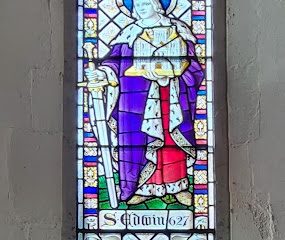

From exile to the throne of Northumbria, discover the remarkable story of King Edwin and his conversion to Christianity in AD627. Explore the events that shaped his reign and Goodmanham’s place in a pivotal chapter of English history.

St. Columba established a monastery on Iona., making it a pivotal site for the spread of Christianity, within a Celtic Tradition. Celtic-speaking areas were part of Latin Christendom at a time when there was significant regional variation of liturgy and structure. But a general collective veneration of the Papacy was no less intense in Celtic-speaking areas but with significanctdifferences: Determining the dating of Easter, a style of monastic tonsure, a unique system of penance, and the popularity of going into “exile for Christ”.
Edwin is born, a son to Ælla, the first known king of the Anglian kingdom of Deira, which he ruled from around 560 until his death.
Ælla was almost certainly a pagan – when Pope Gregory the Great, before his papacy, encountered two pale-skinned English boys (Deirans) at a slave market in Rome he is said to have remarked that they were “not Angles, but angels, if they were Christian”. (Non Angli, sed angeli, si forent Christiani.) and upon learning that the king of Deira was Ælla he said “Alleluia should be sung in that land”
Ælla dies and is succeeded by Æthelric, who is thought to be Edwins elder brother.

Gregory becomes the 64th Bishop of Rome
Gregory send Augustine on a mission, to Britain to Christianise King Æthelberht and his Kingdom of Kent from Anglo-Saxon paganism.
Before reaching Kent, the missionaries had considered turning back, but Gregory urged them on, and in 597 Augustine landed on the Isle of Thanet and proceeded to Æthelberht’s main town, Canterbury.
King Æthelberht converted to Christianity and allowed the missionaries to preach freely, giving them land to found a monastery outside the city walls.
Augustine was consecrated as a bishop and converted many of the king’s subjects, including thousands during a mass baptism on Christmas Day in 597.
Paulinus, a monk from Rome, is sent to the Kingdom of Kent by Pope Gregory I in 601, along with Mellitus and others, as part of the second group of missionaries sent to convert the Anglo-Saxons to Christianity.
This second group of missionaries arrived in Kent, but little is known of Paulinus’s further activities until he went to Northumbria.
Aethelfrith, King of Bernica (who is married Acha, the sister of Edwin), invades Deira, kills Æthelric the Kingcombining the two kingdoms, becoming Northumbria. As soon as he takes over Deira, he exiles Edwin.. The location of his early exile as a child is not known, but late traditions, place Edwin in the kingdom of Gwynedd, fostered by king Cadfan ap Iago, father of Cadwallon.
Oswald the son of Æthelfrith of Bernicia and Acha of Deira is born.
Augustine dies.
Gregory dies.
By the 610s, Edwin was certainly in Mercia under the protection of King Cearl, whose daughter, Cwenburg, he marries Princess Cwenburgh .
By around 616, Edwin was in East Anglia under the protection of King Rædwald. Æthelfrith faced Rædwald in the Battle of the River Idle in 616, and Æthelfrith was defeated; Rædwald installed Edwin as king of Northumbria, the efficacy of Edwin’s kingship ostensibly depended greatly on his fealty to Rædwald.
Æthelfrith’s sons went into exile in Gaelic kingdom of Dál Riata and Pictland. That Edwin was able to take power not only in his native Deira but also in Bernicia may have been due to his support from Rædwald, to whom he may have remained subject during the early part of his reign.
With the death of Æthelfrith, and of the powerful Æthelberht of Kent the same year, Rædwald and his client Edwin were well placed to dominate England, and indeed Rædwald did so until his death a decade later. Edwin expelled Ceretic from the minor British kingdom of Elmet in either 616 or 626. Elmet had probably been subject to Mercia and then to Edwin.
Edwin and Eadbald of Kent were allies at this time, and Edwin arranged to marry Eadbald’s sister Æthelburg.
Eadbald would agree to marry his sister to Edwin only if he converted to Christianity. The marriage of Eadbald’s Merovingian mother Bertha had resulted in the conversion of Kent and Æthelburg’s would do the same in Northumbria.
Failed assassination attempt on Edwin instigated by Cwichelm, the deposed King of Wessex

Edwin converts to Christianity at Goodmanham (site of the most important pagan Saxon temple (dedicated to Woden) in the north of England) by Paulinus who had moved to Northumbria with Æthelburg.
Edwin dies at the Battle of Hatfield Chase (Thorne) defeated by the pagan King Penda of Mercia allied with King Cadwallon of Gwynedd.
Queen Æthelburg flees to Frankia by sea with her children as Cadwallon harries Northumbria for nearly two years.
In Northumbria, Cadwallon and a Welsh army killed Oswald’s elder half-brother Eanfrith who had claimed Bernicia, and also Edwin’s cousin Osric who had claimed Deira.
Upon hearing of the death of Edwin, Oswald prepares to reclaim his father’s Kingdom, uniting Bernicia and Deira once more.
Oswald defeats and kills Cadwallon at the Battle of Heavenfield (Hexham). Before the battle, tradition says Oswald had a wooden cross erected; he knelt down, holding the cross in position until enough earth had been thrown in the hole to make it stand firm
At the request of Oswald, the monastery of Lindisfarne was founded by the Irish monk Aidan, who had been sent from Iona off the west coast of Scotland to Northumbria. The abbey was founded before the end of 634 and Aidan remained there until his death in 651

It was a conflict with the pagan Mercians under Penda that proved to be Oswald’s undoing. He was killed by the Mercians at the Battle of Maserfield, in Oswestry and his body was dismembered.
Oswiu succeeds Oswald as king of Northumbria.
Oswiu defeats King Penda at the Battle of Winwaed (Wentbridge), and becomes king of Mercia, as well as Northumbria.
Osiwu presides over the Synod Whitby (where Hild was Abbess), supporting the Roman version of Christianity as opposed to the Celtic and fixed the method of calculating the date of Easter.
Osiwu dies, succeeded by Ecgfrith.